
2009 Telemark Style
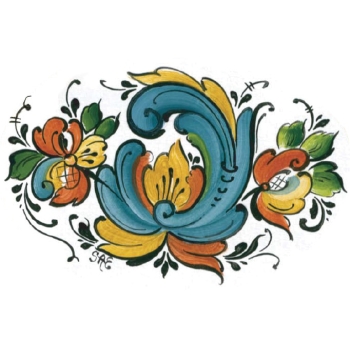
Artist: Shirley Evenstad
With its asymmetric, ornamental stems and flowers, the Telemark style of rosemaling is one of the most popular and easily recognized. Through Telemark’s use of organic shapes and scrolls artists create a dynamic feeling of movement, which carries the eye rhythmically through the design.
Rosemaling from the Telemark region is noted for its transparent and lyrical style. Its color palettes have historically consisted of earth tones. This was mostly due to rural painters access to inorganic native elements, which could be used to produce strong but muted colors; blue pigment, which is a Telemark color, was costly and therefore used sparingly. Today the Telemark color palette still uses these tones and colors while preserving the styles and traditions of Norway's earliest artisans.
2010 Hallingdal Style
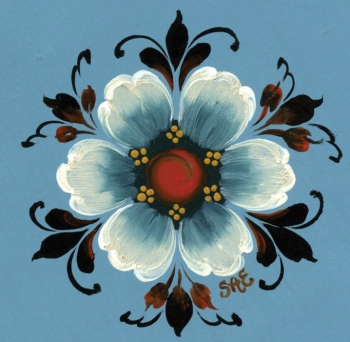
Artist: Shirley Evenstad
The 2010 Hallingdal Rose ornament is a flower found on several trunks and cupboards from some of the earliest rosemaling in Norway and is unique in both focus and technique. Hallingdal style uses flowers as their main design focus with scrolls added to complete a design, opposite from Telemark where the scrolls are the main design element and flowers fill in the spaces.
Hallingdal's strong colors are rich shades of yellow, green, blue and red, and this rose has the blue color "pulled out" from the center blending into white, giving a two-tone, shaded effect. Background colors include orange red, rust red, black-blue, black- green and black. Medium and light blue backgrounds were made popular in this country because people enjoyed them for decorating purposes.
2011 Valdres Style
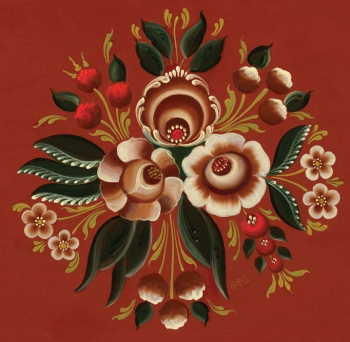
Artist: Shirley Evenstad
The 2011 commemorative Valdres ornament is a cherished example of old style Valdres rosemaling, which is unique because it depicts the flowers as real plants. Often they are shown potted in urns and vases or hung from garlands. In fact, flower clusters suspended on bows are very typical in early samples of Valdres painting.
The flowers in most examples, including this year’s ornament, are the Valdres cabbage-style rose and tulips. This year’s commemorative ornament shows a traditional bouquet as it might be seen from the top. The red background color is very traditional as it was often used on large cupboards and trunks in Valdres.
If you’d like to learn more about Valdres rosemaling, we recommend you see the work of Ole Hermundson Berge who used light backgrounds with blue monochromatic painting, Chinoiserie style. This style of painting was incorporated into his beautiful panels on a large, free-standing cupboard in Valdres. Tree motifs decorated a landscape with stumps and grass onto which large groups of flowers became the focus. He then painted large, colorful flowers using shades of light and dark red, grayish white, yellow ochre, and green incorporated on a light background with long-stretching, extended, s-shaped, lily like leaves, pointed at both ends. These are very typical and a characteristic feature of Valdres painting.
2012 Rogaland Style
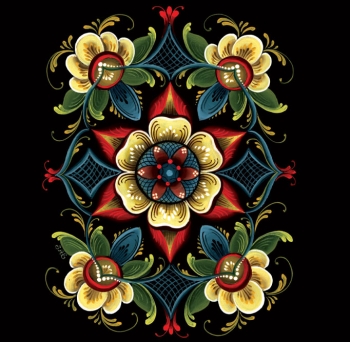
Artist: Shirley Evenstad
The 2012 Rogaland style ornament exemplifies a distinctive American version, which was inspired and developed by Vi Thode of Stoughton, Wisconsin, after studying with Norwegian master painter Bergljot Lunde.
Subtle shading going from very dark to very light on each segment of the design demands excellent brush control and symmetrical precision not found in other styles of painting from Norway. Bright colors were used on dark backgrounds in various shades of blue, red, yellow and green that harmonized with each other and the background. The shading, cross-hatching, colorful tulips and bonnet flowers, and lots of teardrops are very common in most designs making this style very pleasing to view.
2013 Os Style

Artist: Shirley Evenstad
The 2013 Os style ornament exemplifies a unique rosemaling style from the west coast of Norway.
This style uses very bright, pure colors of dark and light red, rich yellows and blues and many shades of green. Numerous flower forms-rosettes, tulips, bonnets, buds, and dual-colored, candy-corn shaped petals give an artist many choices. Groupings of flowers and leaves organically grow on stems with big, round leaves having visible vein lines in large, medium and small sizes to create interest and balance.
This style was often painted on a pure white background. For Americans, this can be shocking and very different from the other styles of rosemaling, and may take some getting used to! However, this year's ornament was instead painted on black to bring out the design of a bright, happy and colorful style that will really stand out on your Christmas tree.
2014 Agder Style
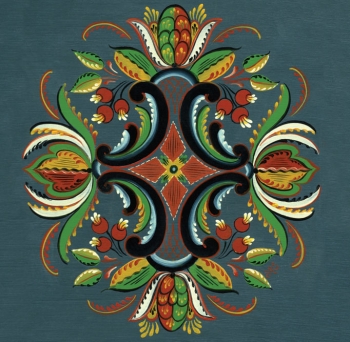
Artist: Shirley Evenstad
This year, Sons of Norway is proud to present the 2014 commemorative Agder style Christmas ornament. Vest-Agder and Aust-Agder counties (fylkes) on the southern coast of Norway border Rogaland and Telemark. Rosemaling is credited to have begun in Fjotland, a small community situated in the interior of Vest Agder, as evidenced by the decoration of Grindheim Church much of it painted by Tore A. Risøyne (1762-1820) one of the most prolific painters documented from this region.
Some of the important identifying characteristics of Agder painting include variations of the tulip which were often flat at the base, designs are most often painted on dark green or dark blue backgrounds, and the leaves and flower centers are divided down the center, with each half painted a different color often with honey-comb or pine-cone-like details decorating them. Colors used are Prussian Blue, Yellow Ochre, English Red and green with details/teardrops provided in white, red, yellow or green. Another signature of the style shows many ferns/leaves/petals painted with lots of teardrops along the vines.
2015 Gudbrandsdal Style
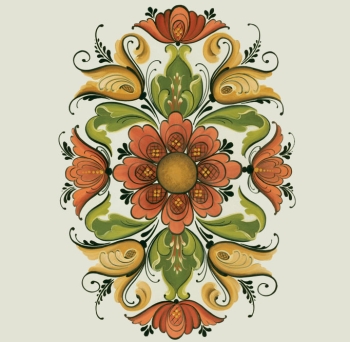
Artist: Shirley Evenstad
Original design: Judy Ritger
The roots of this style come from the classic wood carving district of Norway. The 2015 commemorative ornament displays a painted version of Gudbrandsdalen acanthus carving, and is a homage to the most prominent acanthus master painter Jacob Klukstad (1713-1773), who was from Lesja. The principal motif of the old Lesja school consisted of acanthus branches and jagged foliage with the main stem often ending in an open floral rosette or a tulip.
Gudbrandsdal is one of the most difficult styles to learn and master, with its depth and brightness of colors within each flower and scroll. Colors used were dark-to-light red, Prussian blue, green and gold. The fold-over leaves on the acanthus vines really adds to the drama and beauty of this style. Designs were traditionally painted on dark backgrounds so this year's ornament has a more modern feel when painted on a light-colored, cream background.
2016 Telemark Style
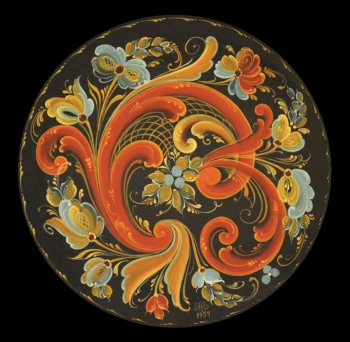
Artist: Shirley Evenstad
The Telemark style of rosemaling comes from an inland area on the southern shore of Norway. Starting in the 1700’s Telemark rosemalers became some of the most prolific of the documented rosemalers. It is a preferred style for many enthusiasts because of the graceful, rhythmical lines and lovely colors. This style is found in the designs on immigrant trunks, door panels, ceilings and beams and smaller objects, such as tankards, porringers and tine boxes. Scrollwork is the main design element with flowers ranging from large to small to fill in spaces between the scrolls.
With a color palette of subdued and earth-toned reds, yellows, blues and greens, this year’s ornament is shaded from dark to light on each element in the design with many graceful embellishments. Traditional background colors were red, dark blue, dark green or black.
2017 Old Style Rogaland
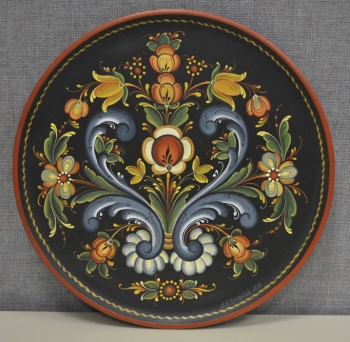
Artist: Shirley Evenstad
Sons of Norway is proud to present our 2017 commemorative Old Style Rogaland Christmas ornament. In many respects it has characteristics of the Telemark style with graceful scrolls, rhythmical lines and lovely shaded colors. Often the designs are symmetrical in nature, but not always.
The color palette includes subdued and earth-toned reds, yellows, blues and greens, and each part is shaded from dark to light on each element in the design with lovely graceful embellishments. Traditional background colors are red, dark blue, dark green or black.
2018 Os Style
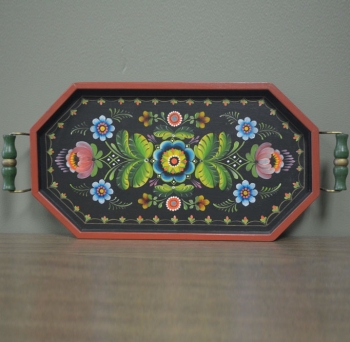
Artist: Shirley Evenstad
The Os style ornament exemplifies a unique rosemaling style from the West Coast of Norway that uses very bright, pure colors of dark and light red, rich yellows and blues and many shades of green. Numerous flower forms—rosettes, tulips, bonnets, buds, and dual-colored, candy-corn shaped petals—give an artist many choices. Groupings of flowers and leaves organically grow on stems with big, round leaves having visible vein lines in large, medium and small sizes to create interest and balance.
This year’s ornament was painted on black to bring out the design of a bright, happy and colorful style that will really stand out on your Christmas tree, but Os was is also painted on pure white, Norwegian red, and medium blue backgrounds, as well.
2019 Telemark Style
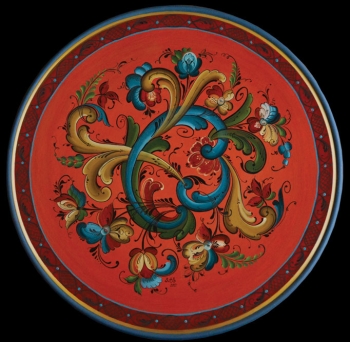
Artist: Shirley Evenstad
As early as 1700 Telemark rosemalers became some of the most prolific of the documented rosemalers coming from an inland area on the southern coast of Norway. Scrolls are the main design element with large and small flowers filling spaces in between the scrolls. With a color palette of subdued and earth-toned reds, yellows, blues and greens, this year’s ornament is shaded from dark to light on each element with many graceful embellishments. Background colors were traditionally red, dark blue, dark green or black. Rosemaling decorated immigrant trunks, door panels, ceilings and beams and smaller objects, such as tankards, porringers and tine boxes.
2020 Telemark Style
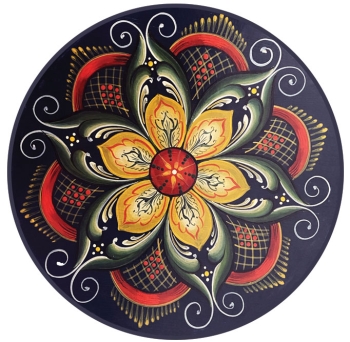
Artist: Judy Ritger
Our 2020 Christmas ornament features a bold design inspired by the Telemark style of rosemaling, which is varied and flexible. Unlike traditional Telemark rosemaling, this year’s Sons of Norway ornament incorporates a high degree of symmetry in its round design.
Against a traditional dark blue background, the bright colors of the floral pattern appear all the more lively to reflect a festive Christmas spirit. The bright red area in the middle pulls the eye toward the central white dot, which serves as a focal point of the design. Moving outward from the center, the yellow ochre blossom features detailed leaf designs within each petal, surrounded by a series of green scrolls around the outside. Decorative red arches connect the scrolls, cornered with yellow teardrop accents that create a gentle starburst pattern. The red dots in the crosshatching between the scrolls add another festive holiday element.
2021 Gudbrandsdal Style

Artist: Judy Ritger
The Gudbrandsdal Valley is an area known for its beautiful woodcarving. This rosemaling style mirrors some of these characteristics in the depth of the leaves with the folded-over edges. Larger rosemaled pieces, such as trunks, will show more of the intertwined scrolls found in woodcarving.
The festive green background evokes feelings of Christmas and the understated design centers on botanical motifs. The large central flower uses a yellow ochre hue favored in rosemaling. The surrounding leaves have a rustic reddish-brown interior and light outer leaves that accentuate the depth. Clusters of three small yellow flowers are commonly used in this regional style. Ornate linework adds embellishment to the design.
2022 Telemark Style
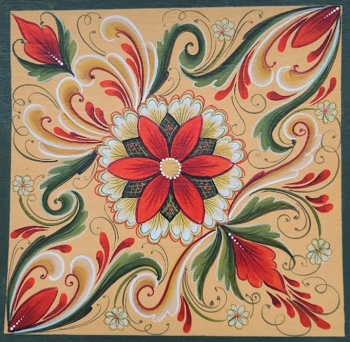
Artist: Judy Ritger
Our 2022 Christmas ornament features a vibrant design inspired by the Telemark style of rosemaling, which is varied and flexible. The ornate floral pattern on a warm ochre background features a large central flower in a bright and festive red, offset by a collar of white leaves. The colors of the surrounding green scrolls remind us of a festive Christmas spirit, and the embellishments of whimsical white flowerlets, curlicues and tendrils accentuate the celebratory theme.
2023 Valdres Style

Artist: Judy Ritger
This year’s limited-edition ornament is based on rosemaling as painted in the Valdres area, a traditional district which lies in the mountains of central southern Norway. Valdres rosemaling emphasizes floral bouquets or groups of flowers, sometimes gathered in a central grouping or hanging from ribbons or a garland. Older Valdres rosemaling often depicted landscapes painted in monotone, sometimes quite Asian in appearance. Today’s version of the Valdres style uses flowers that are fairly realistic– especially roses, tulips, and smaller flowers, with many leaves used to fill out the bouquet. The red oval outer ring gives the tendrils and linework a frame on which to secure the bouquet. The long red flower at the bottom inspires thoughts of Christmas, lending a pop of color with the white teardrops depicting the budding of the flower. The subtle yellow umber background allows the rosemaling details to stand out.
2024 Old Style Rogaland

Artist: Karen Van Loan
Our 2024 Christmas ornament is in the Old Rogaland style from southwestern Norway. Characteristics of the Rogaland style, also called Ryfylke, are the dominant use of flowers—especially stylized tulips, daisies and 4 or 6-petaled roses along with liberal use of teardrop shapes and dots. In this fanciful floral bouquet, cool blue, white and gray tones are offset by a warmer cream-colored background. The use of blended embellishments creates movement in the overall piece.
2025 Telemark Style
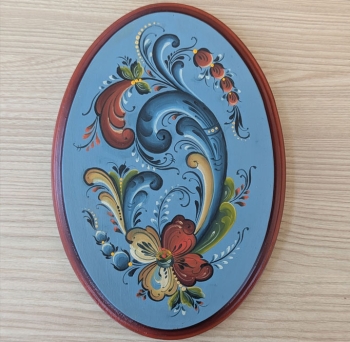
Artist: Karen Van Loan
The foundation of the Telemark style is the asymmetrical C-shaped scroll with graceful scrolls radiating from the main stem. Flowers and leaves are imaginary and fanciful, tucked in to fill empty spaces with blended embellishments, graceful linework and teardrops. Typically, Telemark design has an elegant appearance with color playing an important role in the design.
The ornate pattern on a bright blue background features a grounding central flower in festive red, orange and cream colors, offset by tendrils with white leaves. The colors of the scrolls in deep red, yellow umber, blue and green lend uplifting flair, and the whimsical white flowerlets and curlicues accentuate the holiday spirit.