
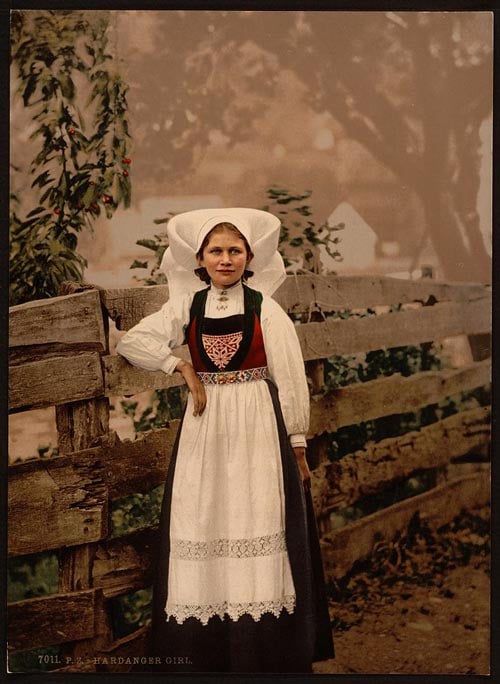
 The Norwegian bunad is an icon of Norwegian heritage which many women and men wear with pride on Syttende Mai, Norway’s constitution day. A bunad takes a lot of time to create, and with pricing in the $3,000 to $5,000 range, bunads are not accessible to everyone.
Enter the festdrakt and fantasi bunad. The first has a similar shape, but fewer bespoke details like embroidery, beading and woven ornamentation. Another nuance that differentiates a festdrakt from an official bunad is that it’s often made with fabrics other than wool. A fantasi bunad gives the maker even more license to create a festive garment with an unusual color palette or upcycled textiles.
For some, these offbeat bunads are a way to reclaim textiles, saving them from the landfill. For others, they are budget-friendly. They can also be an expression of creativity and a flex of your sewing skills. And for many with a foot in two cultures, a fantasi bunad can be a garment that expresses Norwegian heritage and reflects another part of their background—like incorporating Congolese fabric into the profile of a bunad, as Godwin Production does with their stunning multi-cultural festdrakt.
Fæbrik, a re-design collective based in Oslo, has built a brand around upcycling, and created digital festdrakt patterns for people to print and sew their own festive outfits. A wordplay on the English “fabric” and the Norwegian word for “factory,” Fæbrik makes downloadable patterns, step-by-step videos and offers user-friendly tailoring tips so that each person can create their ideal fit.
Just like that, a pair of lace curtains gains new life as an apron, and a hand-stitched pillowcase is reimagined as a vest. The group has hosted “fæstdrakt” parades in Oslo’s Frogner Park- see the photos in the linked pattern for the myriad ways to express one’s creativity in this modern take on a folk costume.
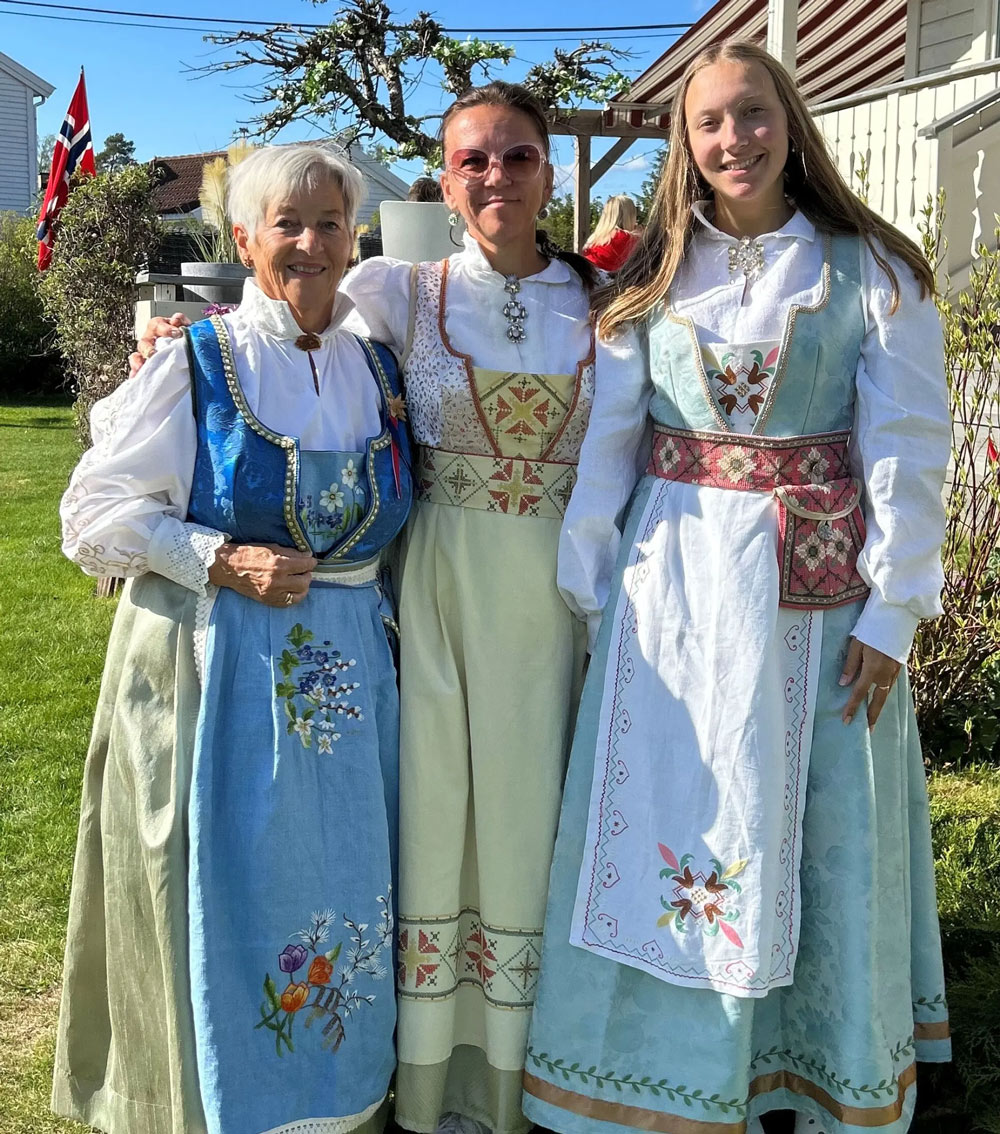
Kjerstin with her mother Aina and daughter Mathilde. Both are delighted with the party outfit she has created.
Photo Source: https://www.klikk.no/reportasje/hver-festdrakt-kjerstin-syr-er-helt-unik-7622980
Kjerstin Teigen Granby from Ski in Akershus was a social worker and hobby redesign sewist. In 2024, she launched Omform design (“reshape”) where she re-imagines needlepoint and weavings into fantasi bunads. She also makes beautiful mittens from traditional tapestries. She told Hjemmet weekly magazine that she likes that the components of a drakt give her room to mix, match and compose looks. Mostly self-taught, Granby is really comfortable with improvisation. A turning point in her journey from amateur to professional was discovering Fæbrik’s drakt pattern. First, she made a drakt for herself, followed shortly by ones for her daughter and mother. By then, she was having so much fun, she kept going and posted one that sold immediately on Finn.no.
She was hooked by the freedom to create whatever she wanted. Now she combs flea markets and thrift stores for treasures, always with her next festdrakt in mind. Granby loves that each piece is totally unique and gets to have a new life through her designs. A lot of the time, the thrifted pieces are lovingly embroidered by hand, like the parts of a traditional bunad.